



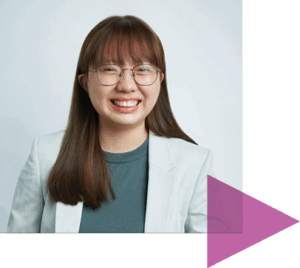
CHAN CHIN YEE
Chemistry & Biological Chemistry (2020)
TELL US ABOUT YOUR ROLE AND MAIN RESPONSIBILITIES
I am a Product Development Chemist at SDC Technologies Asia Pacific, an affiliate of the Mitsui Chemicals Group in Singapore. My main responsibilities include developing hard-coat and anti-fog products to build a commercially viable functional coating pipeline. I work on the development of formulas, processes, and methods to solve technical problems.
WHAT MADE YOU PURSUE A CAREER IN THIS INDUSTRY?
As a chemistry graduate, I am drawn to translating science into practical solutions that improve people’s lives. Product development in the chemical industry is where ideas meet impact: it lets me pair rigorous science with hands-on experimentation, collaborate with cross-functional teams and turn small molecular choices into practical, high-performance products. It keeps me close to the lab while also shaping real world decisions. That blend of curiosity, problem-solving and visible results aligns with how I like to work, thus motivating me to stay in this sector while pursuing continuous improvement.
WHAT DO YOU ENJOY MOST ABOUT THIS ROLE?
I enjoy the clarity of turning questions into experiments and experiments into decisions. I design and run hands-on tests, iterating until patterns reveal better formulas or processes. The spark comes when those patterns point to a breakthrough; that moment is the best part. This continuous learn-and-iterate flow keeps the work fresh and accelerates my growth. I also value the bridge between research and manufacturing, as it translates data into stable processes and products people rely on. Closing that loop from idea to impact is incredibly motivating and makes this role exciting every day.
WHAT WERE SOME CHALLENGES YOU FACED AND HOW DID YOU OVERCOME THEM?
As a chemist who spends most of my time at the bench, a recurring challenge is balancing hands-on work with the reflection and research that guides it. When pushed to move quickly at the bench, it is easy to end up running in circles. I learnt to pause deliberately and block focused time to review data, note anomalies and consult literature or experienced colleagues to close knowledge gaps. With these inputs, I define the simplest follow-up experiment, refine the plan, set measurable success criteria and schedule the test. Taking deliberate time to think and plan strategically helps me to move efficiently at the bench while keeping the big picture in view and ensuring each experiment meaningfully advances the project.
WHAT IS NEEDED TO BE SUCCESSFUL IN THIS ROLE?
You need to be self-motivated. Design your own experiments, ask sharper questions and make your learning visible. Treat setbacks like coursework – study them, extract lessons and iterate quickly. Staying updated with the latest technologies is crucial, as your skill set should evolve just as fast; then let creativity guide how you apply them at work.
Above all, keep growing. Stay open-minded, avoid locking into a single route, develop options and let data make the call. Learn new methods, explore new materials and keep stretching your judgment. That blend of curiosity, continuous upgrading and data-driven decision-making is what turns good chemistry into reliable products.
SHARE YOUR ADVICE WITH STUDENTS WHO ARE KEEN TO PURSUE A CAREER IN YOUR INDUSTRY.
For students interested in pursuing a career in chemistry, enter the field with wide eyes and open hands. Get as much exposure as early as possible, especially during university, by joining a research group, taking internships and shadowing in labs. Chemistry spans many paths, so explore widely to find what truly aligns with your curiosity and long-term goals.
Connect the dots across classes, projects and industry talks. Blend knowledge from multiple sources and focus on details that turn ideas into reality.
Finally, do not fear failure, because each “no” paves the way to the next “yes.” Be open-minded, avoid boxing yourself in and keep growing.


SOME SKILLS AND TRAITS THAT ARE NEEDED FOR THE ROLE
- Laboratory experiences
- Resilience
- Cross-functional communication
- Growth mindset
- Data-driven creativity
- Systems thinking